Eternal Wall of Answered Prayer
A Living Testimony in Spirit & Stone
 Throughout Scripture, God commands His people to remember, to hold fast to the testimonies of His faithfulness.
Visible to all
The ‘Eternal Wall of Answered Prayer’ rises from that ancient command, and will stand as a modern ‘matzevah’ a monument not of kings or empires, but of answered prayers.
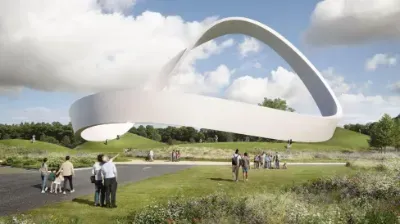
Constituting the UK's largest Christian monument, the structure will be built near Coleshill in Warwickshire. and will contain around one million bricks. A ground-breaking ceremony signalling the start of construction took place earlier this month, and the structure is scheduled to be completed by 2028. To be built in the form of a Mobius strip, the ‘Eternal Wall of Answered Prayer’ will be 51 metres tall (twice the height of ‘Angel of the North’) and will be visible to more than 500,000 every day.
As Michelle Heritage shared in the project’s personal interview with Prophecy Today, this vast national landmark will contain an initial 250,000 testimonies of answered prayer by 2028. Each brick will tell a story, a remembrance, an act of divine faithfulness made visible.
A wall of remembrance
In Hebrew thought, to remember (זָכַר, zakar) is not mere mental recall, it is an act of participation. When Israel remembered the Exodus, they entered again into the redemption narrative. When Yeshua broke bread and said, “Do this in remembrance of Me” (Luke 22:19), He was inviting His followers not just to recall, but to re-enact covenant fidelity.
The ‘Eternal Wall of Answered Prayer’ will be twice the height of ‘Angel of the North’ and will be visible to more than 500,000 every day.
So too, Eternal Wall calls this generation to remember to bear witness to how God answers prayer, heals, restores and saves. Each testimony is a living ebenezer (אֶבֶן הָעֵזֶר, a “stone of help,” 1 Samuel 7:12), declaring: “Thus far has YHWH helped us.”
From the wilderness wanderings to the Temple mount, Israel’s story is filled with stones that testify. After crossing the Jordan, Joshua commanded one man from each tribe to take a stone and build a memorial:
“When your children ask in time to come, ‘What do these stones mean to you?’ then you shall tell them how the waters of the Jordan were cut off before the ark of the covenant of YHWH… so these stones shall be to the people of Israel a memorial forever.” (Joshua 4:6-7)
Eternal Wall continues this biblical pattern. It stands as a gal-ed (heap of witness), not to human ingenuity but to divine mercy.
Each answered prayer will function as a testimony stone, digital, visible, searchable through augmented reality, yet rooted in the same spiritual impulse that drove Joshua’s twelve tribes. When a generation yet unborn looks upon it, they will ask, “What do these stories mean?” And we will tell them of the God who still hears.
An Hebraic rhythm to testimony
In Hebraic thought, testimony (edut, עֵדוּת) is sacred. It is more than proof, it is covenant evidence that the God of Abraham, Isaac, and Jacob is alive and active. The Psalmist declares:
“I will meditate on Your precepts and regard Your ways. I will delight myself in Your statutes; I will not forget Your word.” (Psalm 119:15-16)
Testimony preserves memory, but it also releases power. Revelation 12:11 captures this mystery: “They overcame him by the blood of the Lamb and by the word of their testimony.”
The Eternal Wall becomes, therefore, not merely an archive of gratitude but a living intercession, a continuous prophetic declaration
In Hebrew thought, the word (davar) is not abstract, it carries substance, creative force. When we speak of God’s faithfulness, we re-release His promise into the atmosphere. The Eternal Wall becomes, therefore, not merely an archive of gratitude but a living intercession, a continuous prophetic declaration: “He who promised is faithful.”
Symbols of covenant security
The design of the Eternal Wall, ultimately 1,000,000 answered prayers embedded within a vast curved structure, echoes the prophetic motif of walls throughout Scripture. Walls are not only boundaries; they are symbols of covenant security and divine faithfulness.
Isaiah prophesied: “You will call your walls Salvation, and your gates Praise.” (Isaiah 60:18)
In Nehemiah’s day, rebuilding Jerusalem’s walls was an act of spiritual restoration. Each section represented families, tribes, and their willingness to defend what God had entrusted to them. Likewise, this modern wall is not defensive, it is declarative. It proclaims salvation and praise over a nation often uncertain of its spiritual identity.
In Hebrew idiom, a wall (chomah) symbolises strength derived from God’s covenant. Eternal Wall therefore embodies a national teshuvah, a turning of hearts back to the God who answers prayer.
Commentary on God’s Word
The Eternal Wall’s purpose is not to glorify miracles, but to glorify the God of miracles. The testimonies gathered - stories of healing, provision, salvation, reconciliation - become modern psalms. Michelle Heritage described how the project has drawn stories from intercessors, street pastors, and ordinary believers who have seen God act in their lives.
The project has drawn stories from intercessors, street pastors, and ordinary believers who have seen God act in their lives.
These are not polished narratives of perfection, but raw, real stories, like David’s psalms, full of both tears and triumph. The Hebraic tradition honours such honesty. The Psalms themselves are filled with cries of “How long, O YHWH?”, followed by declarations of trust. To record an answered prayer, then, is to acknowledge both the waiting and the fulfilment, to make visible the divine rhythm of lament and joy.
The Eternal Wall is, in many ways, a physical commentary on God’s Word. Each testimony mirrors the faith journey of those who “believed that He is, and that He rewards those who diligently seek Him” (Hebrews 11:6).
Hebrew faith is embodied faith, heard in the Shema (“Hear, O Israel”), seen in the mezuzah fixed to the doorpost, lived in the festivals of remembrance. This wall continues that embodiment. It transforms invisible faith into visible architecture, inscribing prayer into the public square.
Just as the prophet Habakkuk was told to “write the vision, and make it plain upon tablets” (Habakkuk 2:2), so too does this wall make plain the vision of divine faithfulness. Each prayer becomes a mikhtav elohim, a letter written not with ink, but with the Spirit of the living God (2 Corinthians 3:3).
New tools for ancient truth
One of the most innovative aspects of the Eternal Wall is its use of augmented reality, a digital means of encountering testimony. In a sense, this technology serves as a 21st-century tabernacle: a meeting place between heaven and earth.
This is not the first time God’s people have used new tools to bear ancient truth.
In Exodus, the Mishkan (Tabernacle) was constructed as a dwelling for God’s presence among His people. Its blueprints were divinely inspired, filled with symbolism and precision. Likewise, the Eternal Wall has been designed with spiritual intentionality. Its digital component, an app through which users can view prayers, search themes, or add their own, extends the tabernacle’s openness to the digital generation.
This is not the first time God’s people have used new tools to bear ancient truth. The printing press carried the Scriptures into every tongue; the internet now carries testimony into every home. The wall thus becomes a sanctified network, a global altar of remembrance.-
God’s presence
Michelle Heritage described her hope that visitors would simply “feel something different on the land”, a modern echo of Jacob’s exclamation at Bethel: “Surely YHWH is in this place, and I did not know it!” (Genesis 28:16)
Bethel, literally House of God, was marked by a stone pillar that Jacob anointed after seeing the ladder between heaven and earth. The Eternal Wall may well become such a Bethel for Britain, a place where heaven touches earth through stories of answered prayer.
The Eternal Wall may well become such a Bethel for Britain, a place where heaven touches earth through stories of answered prayer.
This is profoundly Hebraic: faith not confined to temples or cathedrals, but encountered in makom kadosh, the holy place where testimony resides. As the Psalmist declares, “One generation shall declare Your works to another” (Psalm 145:4).
Timing
The timing of this project is no accident. The ground-breaking in 2024 marks roughly twenty-one years since the original vision, a cycle reminiscent of the Hebraic pattern of Shemitah (seven-year rest) and Yovel (Jubilee, the fiftieth year).
In biblical numerology, seven represents divine completeness; three cycles of seven (21 years) suggest a season of perfected preparation. Breaking ground, therefore, carries prophetic resonance. The soil of England receives not just foundations of concrete but of covenant memory.
As the project aims toward 2028, we might note that 2028 will be 80 years since the founding of the modern state of Israel, a symbolic parallel of restoration. In Hebraic understanding, such convergence of cycles often signals divine orchestration.
Teaching hub
Beyond the physical structure, the Eternal Wall includes plans for a 24/7 prayer room and an education hub. This echoes the Levitical pattern of continual worship and instruction. The priests of old were not only intercessors but teachers, those who guarded the covenant knowledge of the people (Malachi 2:7).
Eternal Wall may stand in England’s heartland, but its message is global: God answers prayer everywhere.
The education hub’s mission to teach about prayer, testimony and evangelism situates the wall within the rhythm of talmidut, discipleship. In the Hebraic model, learning is always relational, experiential and cyclical. The hub becomes a ‘beit midrash’ (house of study) for a new generation learning to see God’s hand in history. This resonates with Isaiah’s prophecy:
“Many peoples shall come and say: ‘Come, let us go up to the mountain of YHWH… that He may teach us His ways and that we may walk in His paths.’” (Isaiah 2:3)
Answered prayer
Eternal Wall may stand in England’s heartland, but its message is global: God answers prayer everywhere. In Hebrew idiom, the nations (goyim) are invited not as spectators but as co-heirs of the covenant promise (Ephesians 3:6). Thus, an Italian believer standing beside an English family’s answered prayer participates in the same story, the story of Emmanuel, God with us.
In Hebraic-Christian thought, answered prayer is never random. It is the amen to divine promises. The Hebrew root anah (to answer) is related to ani (I am). Each answered prayer is, therefore, a fresh revelation of the “I AM” responding to His people. Yeshua Himself taught that the Father’s glory is revealed in answered prayer:
“Ask, and you will receive, that your joy may be full.” (John 16:24)
Eternal Wall chronicles not transactional prayer, but relational faith, the ongoing dialogue between Creator and creation.
But He also framed prayer within covenant obedience: “If you abide in Me, and My words abide in you, ask whatever you will, and it shall be done for you.” (John 15:7)
Eternal Wall gathers not just outcomes, but obedience stories, moments where faith persisted in the silence and rejoiced in the response. It chronicles not transactional prayer, but relational faith, the ongoing dialogue between Creator and creation.
Prophetic symbolism: From ruin to resurrection
The imagery of breaking ground carries rich biblical symbolism. Isaiah 58:12 speaks of those who “shall build the ancient ruins” and “raise up the foundations of many generations.” To break ground for the Eternal Wall is to break spiritual ground for national renewal.
In Ezekiel 37, God commands the prophet to speak to dry bones, and they rise as a living army. Likewise, the Wall’s testimony transforms spiritual desolation into proclamation. Where cynicism has settled, hope is resurrected. Michelle Heritage noted that many of the testimonies are “raw and authentic”, reflecting prayers answered through grief, struggle and endurance. This echoes the Hebrew understanding of emunah, faith as steadfast trust rather than passive belief. Such faith, forged in adversity, is the foundation upon which this wall stands.
A Modern Psalm for the nations
If David were writing today, perhaps his psalms would take the form of these testimonies—digital scrolls of praise spanning nations and generations. Each story is a mizmor, a melody of remembrance. Together they form a collective psalm, rising like incense before God (Psalm 141:2).
This echoes the Hebrew understanding of emunah, faith as steadfast trust rather than passive belief. Such faith, forged in adversity, is the foundation upon which this wall stands.
As the wall’s structure takes shape, it becomes a visual metaphor for the living temple Paul described:
“You also, like living stones, are being built into a spiritual house.” (1 Peter 2:5)
Thus, Eternal Wall does not replace the Church, it mirrors it. Both are constructed of stories, each stone representing a life redeemed, each gap filled with grace.
In the modern world of instant results, the Eternal Wall invites us back to the long view, the Hebraic patience that trusts God across generations. Abraham prayed for a son and waited decades. Moses prayed for deliverance and saw it fulfilled in his successor. Daniel prayed for restoration and saw only visions of it. Yet all believed.
The wall’s construction process, spanning decades from vision to reality, mirrors that enduring faith. Its completion will stand as a reminder that God’s timing is perfect, His promises sure, His faithfulness eternal.
As Psalm 100:5 declares: “For YHWH is good; His mercy is everlasting; and His truth endures to all generations.
When Yeshua entered Jerusalem, the Pharisees asked Him to silence His disciples’ praises. He replied, “If they keep quiet, the stones will cry out.” (Luke 19:40)
In a time when faith is often privatised, this wall stands boldly in the public square.
God still answers prayer
The Eternal Wall is the fulfilment of that declaration, stones crying out across a nation, each bearing witness that God still answers prayer. It is not a monument to human achievement, but to divine constancy.
In a time when faith is often privatised, this wall stands boldly in the public square. It proclaims what Israel’s prophets, priests and poets have always declared:
“Not unto us, O YHWH, not unto us, but to Your name give glory, for Your steadfast love and faithfulness.” (Psalm 115:1)
The Eternal Wall of Answered Prayer is more than architecture, it is testimony incarnate. It calls the world to remember, to believe again, and to join the ancient chorus that still rings from Jerusalem to the ends of the earth:
“Give thanks to YHWH, for He is good; His mercy endures forever.” (Psalm 136:1)
Readers are warmly invited to share their answered prayers by heading to the official website testimony page
(Top image: An artist’s impression of ‘Eternal Wall of Answered Prayer’ (c/o Snug Architects)
Nick Thompson, 18/11/2025