The Mystery of the Nativity
How Did the Shepherds Know Where to go to Find the Baby Jesus?
 It was Christmas Day, 2017. Both my sons were away from home, so my husband and I found ourselves sat around the festive table of some good friends, having been invited there for lunch. It seemed a bit random when our host suddenly said across the table “So how did the shepherds know where to go to find the baby Jesus?” I think I must have spluttered something about a star and angels… but it set me on a path to make my own journey of discovery, a little of which I share below.
Christmas tradition
The date of Jesus’ birth is uncertain. It was almost definitely not December 25th. I believe it is much more likely to have been in September or October, during the Feast of Tabernacles. This is the feast that points to the coming of Messiah to dwell among His people. We look to this feast for prophetic insight towards Jesus’ second coming, so it makes sense for His first to have also fallen in this season.
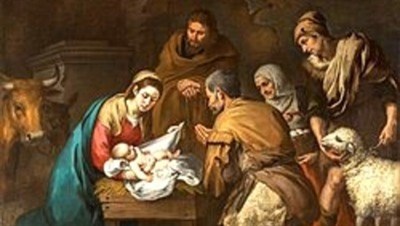
We’re all familiar with the image of the typical nativity scene: a transection of a wooden shed, with Mary and Joseph sat in the centre and the baby lying on some hay in a little crib surrounded by animals. The scene usually includes a bright star, a host of angels, a few shepherds, some lambs and the wise men.
Most of us are also familiar with the typical school or church nativity which embroiders this further with the appearance of the brutally uncaring inn-keeper and an even greater variety of animals. One of my sons was once an oyster!
The date of Jesus’ birth is uncertain. It was almost definitely not December 25th.
During the 4th century, Emperor Constantine’s mother, Helena, undertook a tour of the Holy Land in which she ‘identified’ almost all the now well-known sites associated with Jesus e.g. the Holy Sepulchre and the Church of the Nativity. E.g. Helena identified the crucifixion site as the site on which the well-known basilica of the Holy Sepulchre is built, yet at the time of the Second Temple, this site was within the city walls, not outside. Leviticus 4: 12 tells us that the sin offering has to be sacrificed outside the city walls. So, there is a much more likely site alongside the Garden Tomb where the rock formation clearly bears the face of a skull (Matt 27:33).
So too, with her identification of the site of Jesus’ birth. Tradition says Jesus was born in a cave over which the basilica of the Nativity was built but there is no biblical evidence for this. In fact, as we shall see, the biblical evidence points to a much more rural setting.
The nativity is recorded in two of the gospels: Matthew 1:18-2:12 and Luke 2:1-20. Matthew’s account outlines the betrothal of Mary and Joseph but does not give us any details at all about the actual nativity; instead it leaps forward into the coming of the Magi. This event I consider to have been most likely, because of the historical insights given, at least two years later, as recorded in Matthew 2:1; “After Jesus was born in Bethlehem in Judea, during the time of King Herod, Magi from the east came to Jerusalem…”
Luke’s narrative does tell us about the nativity, but it gives no geographical specifics, and the account almost exclusively concerns the reaction of the shepherds to the angelic visitation. From this we can understand that the shepherds are important, so we need to pay attention to them.
The Shepherds and the sheep
To be a shepherd was a lowly occupation. Young King David, the youngest and seemingly most insignificant of Jesse’s sons, was sent into the wilderness to tend his father’s flock (1 Sam 16:19), which are identified as being near Bethlehem (1 Sam 17:15). “David went back and forth from Saul to tend his father’s sheep at Bethlehem.”
Luke's account almost exclusively concerns the reaction of the shepherds to the angelic visitation.
To find this location, we must go back to Genesis 35. This is the account of the death of Rachel during the birth of Benjamin.
“Rachel died and was buried on the way to Ephrath (that is, Bethlehem) … Israel moved on again and pitched his tent beyond Migdal Eder.” (verses 19, 21)
Having buried Rachel, Jacob moved his flocks to Migdal Eder. This is a location northeast of current day Bethlehem, about four miles south of Jerusalem. Excavations along modern highway 60 may well have identified the site.
Migdal Eder translates as ‘watchtower of the flock.’ So, this is clearly a significant place for the shepherds, within walking distance of the Temple where Numbers states that two lambs must be sacrificed daily as sin offerings:
“This is the food offering you are to present to the Lord: two lambs a year old without defect, as a regular burnt offering each day. Offer one lamb in the morning and the other at twilight…’ (28:3-4).
These offerings were specifically male lambs, each without spot or blemish. It is from these same sheep that the sacrifice for the annual Passover and for the High Priest at Yom Kippur would have also been chosen.
They would have also been aware of the Messianic prophecies that link the coming of Messiah to Migdal Eder.
The Mishnah expressly forbids the keeping of sheep, apart from those in the wilderness, except for those used in the Temple ritual (Baba K 7:7). So, we can discern that the sheep kept at Migdal Eder, just a few miles from Jerusalem, were no ordinary sheep and that the shepherds who cared for them were either Levites or set apart for the care of the sheep intended for the Temple sacrifices. That being the case they would have also been aware of the Messianic prophecies that link the coming of Messiah to Migdal Eder.
“As for you, watchtower of the flock, stronghold of Daughter Zion, the former dominion will be restored to you; kingship will come to Daughter Jerusalem.” (Micah 4:8).
“But you, Bethlehem Ephrathah, though you are small among the clans of Judah, out of you will come for me one who will be ruler over Israel, whose origins are from of old, from ancient times.” (Micah 5:2).
The sages understood both scriptures to be about the coming of Messiah. The former links His appearing specifically to Migdal Eder.
The manger
Our cosy nativity scene represents the manger as a tiny crib-like feeding trough in the outbuildings of a village pub. But, if we look to the Greek, we find the word phatne, translated ‘manger’ is an animal stall, even a birthing stall.
We can assume that the manger was the birthing stall at Migdal Eder where the sheep born to be sacrificed at the Temple were born and raised.
If we consider the Greek in Luke 2: 7, there is no indefinite article ‘a’. It does not read “…she laid him in a manger”, as if there were many such mangers. Literally, Mary, having given birth lays him in [the] manger. This is repeated in verse 12. In verse 16 the definite article appears in the text:
“And they came hastening, and found both Mary and Joseph and the babe lying in the manger.”
We can assume that the manger was the birthing stall at Migdal Eder where the sheep born to be sacrificed at the Temple were born and raised.
The swaddling bands
One of the vital roles of these shepherds was, at the birth of each lamb, to inspect it for blemishes and defects. Then, to carefully wrap those who were chosen in binding cloths to protect them from injury before they were sacrificed.
The Levitical priests would take turns of two-weeks duty in the Temple (see Luke 1:8-9 concerning Zechariah). When they came off duty their priestly garments were shredded, so it is very likely that the strips of cloth that the lambs were bound with, were in fact their own shredded vestments. As Mary had previously visited her cousin Elizabeth when Zechariah came off duty, it is even possible that the cloths used to swaddle baby Jesus might have come from this source. That is obviously conjecture, but entirely possible.
The angelic directive
Having laid out the evidence, it is now no surprise to find that when the shepherds received the angelic visitation, they knew exactly where to go and why it was to them that the angels came.
When the shepherds received the angelic visitation, they knew exactly where to go and why it was to them that the angels came.
It was their holy calling to prepare the lambs for sacrifice. Having heard of the ‘sign’ they were to find, they hurried away to the manger and found the ‘lamb of God’ born to be the once for all Passover lamb who would take away the sins of the world (John 1:29; Heb 7:27), swaddled - to signify he was without spot or blemish - lying in the birthing stall; the place where those destined to be sacrificed were born.
As Levites - and understanding this from the prophetic teachings of Micah, the Mishnah (Shekinah 7:4), the Talmud (Berekot 2:3), Targums and the sages - they would have immediately understood what they were being shown.
No wonder they quickly set about telling everyone around them the ‘good news’ of the coming of the Messiah who would live to incarnate, illustrate and demonstrate the inbreaking reality of the presence and power of the Kingdom of God among mankind.
Sarah Winbow, 24/12/2025