Was Jesus a Palestinian?
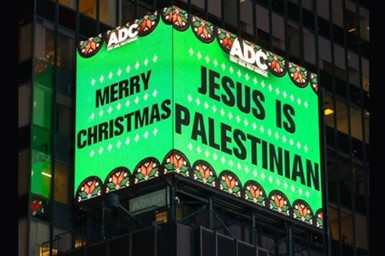 A common refrain that can be heard, particularly around Christmas time, is the claim that ‘Jesus was a Palestinian’. Now, ever since Christianity spread across the world, people have tended to view Jesus as reflecting their own sense of identity – recognising the Messiah as one of us – whatever our ethnicity. It can be both helpful and unhelpful, depending on how it is done. But these claims are overtly political in an attempt to subvert Christian’s understanding of the Jewish identity of Jesus and promote pro-Palestinian support – yet they are wholly based on fiction.
Historical use of ‘Palestine’
To understand this, first and foremost, it’s crucially important to define ‘Palestine’. For centuries, including during late-Roman, Byzantine, and early Islamic rule, ‘Palestine’ remained a geographic or administrative term, not a national identity. However, during the Ottoman period, the area of Palestine was absorbed into the Damascus ‘eyalet’ and divided into areas termed ‘sanjaks’, named after Safed, Nablus, Jerusalem, Lajjun and Gaza. ‘Palestine’ was not officially used by the Ottomans, but persisted in popular and semi-official contexts, often linked to the notion of the Holy Land.1
Notably, neither Arab nor Ottoman sources recognised a distinct Palestinian people.
Notably, neither Arab nor Ottoman sources recognised a distinct Palestinian people. In the late 19th and early 20th centuries, Jews living in the region, including both Zionist immigrants and those whose families had lived there for generations, simply referred to themselves as Palestinians in the geographic sense. Jewish newspapers, businesses, and institutions used the term without controversy, because it implied no exclusive ethnic ownership.
The ‘Palestine’ label was administratively reinforced by ‘The Mandate for Palestine’, issued by the League of Nations for British administration of the territories of Palestine and Transjordan, formerly part of the Ottoman Empire. The mandate was assigned to Britain in April 19202, and the term remained as a territorial rather than an ethnic designation. Now, however, the term is used in reference variously to the combined geographical area of Israel and the ‘Palestinian territories’ of Gaza and the West Bank, sometimes only the ‘Palestinian territories’, and also in reference to the people who live there.
Claims of Jesus the Palestinian
The claim about the identity of Jesus is a very recent phenomenon, widely promoted by Palestinian Arabs and pro-Palestinian westerners. Perhaps the most famous examples came from the lips of Yasser Arafat (who was actually Egyptian), who declared: “Jesus was the first fedayee who carried his sword for Palestine”3 (a ‘fedayee’ being a commando-style militant). The incongruity of this is staggering. Clearly Arafat hadn’t paid attention to Jesus’s rebuke of Peter, when He said, “Those who live by the sword will perish by the sword” (Matt 26:52).
The claim about the identity of Jesus is a very recent phenomenon, widely promoted by Palestinian Arabs and pro-Palestinian westerners.
Arafat also regularly called Jesus “the first Palestinian martyr”. Mahmoud Abbas has echoed similar sentiments, calling Jesus “a Palestinian messenger”4. When Arafat triumphantly took control of Bethlehem in December 1995, he told a throng gathered in Manger Square that he was there to liberate “the birthplace of our Lord the Messiah … the city of the Palestinian Jesus!”5
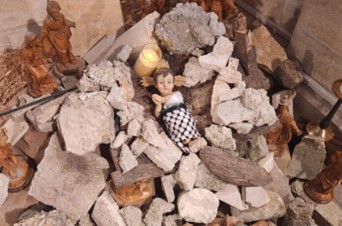 But perhaps the most egregious examples come now annually from Bethlehem. For example, the 2023 Christmas Eve sermon by Rev. Munther Isaac, Academic Dean of Bethlehem Bible College, was titled, ‘Christ in the Rubble’, given in the Evangelical Lutheran Church. The sermon went hand-in-hand with a display in Bethlehem depicting Jesus as a Palestinian baby, surrounded by concrete debris.6
Referring to the manger scene, he said, “this manger is about resilience, about sumud …” ‘Sumud’ is an Arabic term, meaning ‘steadfastness’, a steadfastness that may be passive or active, in the latter case to resist and undermine Israeli authority. Fully aware of the volatileness of the political situation, one would have thought that a minister of the Gospel would at least have been more cautious. Paul’s advice to the early Christians in Rome was, “Let every soul be subject to the governing authorities. For there is no authority except that which is from God. The authorities that exist have been appointed by God.” (Rom 13:1)
Significantly, we find that this ‘Evangelical’ scholar has, by his own admission, departed from the Biblical perspective on the land of Israel, unashamedly stating, “For my Ph.D., I wrote about the Promised Land. Now I want you to think about the logic behind the assumption that the solution to Palestinian misery, or the occupation, lies in the question, ‘To whom does the Bible say that the land belongs?’ Only after I finished my Ph.D. did I realize, ‘What a stupid assumption. Is there any other context in which we impose a solution based on a religious understanding? The Palestinian issue is about colonialism and theft of land and ethnically cleansing the indigenous people.’”7
A global distortion
Extending the global reach of these distortions, on December 7th 2024, Pope Francis prayed in front of a Nativity scene that was crafted in Bethlehem, in the Paul VI Hall at the Vatican, Saturday, Dec 7, 2024, in which ‘baby Jesus’ appeared in a manger draped with a Palestinian keffiyeh.8 In global reach, however, much more publicly significant is that the issue has gained considerable momentum this winter, when Times Square, New York, gained this display, funded by the American-Arab Anti-Discrimination Committee.
Divisively, the sponsors also announced that “By using these billboards, we … reclaim the truth, honoring the Palestinian refugee born in Bethlehem.”9 Yet Jesus was not born a refugee. Yes, he became one, when the family fled Herod after the magi’s visit – He was not one at the time of His birth. Moreover, the absolute truth is that ‘Palestine’ did not exist at the time of Jesus’s birth – not until the suppression of the Jewish Bar Kokhba Revolt did the Romans create the province of ‘Syria Palaestina’ in 135 AD. When Jesus the Jew, Yeshua ben David, was born, the region was the province of Judaea, governed by Herod Archelaus on the authority of Caesar Augustus.
‘Palestine’ did not exist at the time of Jesus’s birth – not until the suppression of the Jewish Bar Kokhba Revolt did the Romans create the province of ‘Syria Palaestina’ in 135 AD.
It is natural for people to seek to match Jesus’ struggles with our own – for example, Hebrews 4:15 describes how Jesus, our high priest, can empathise with our weaknesses, having faced temptations. It is a whole further step to appropriate His identity, and make it into a political football – all while undermining such a crucial aspect of His life: that He was born a Jew, one who came to bring light to all peoples as promised in the Jewish Scriptures.
Endnotes
1. https://history-maps.com/story/History-of-Palestine/event/Ottoman-Period-in-Palestine
2. Wikipedia: Mandate for Palestine
3. https://archive.bridgesforpeace.com/article/unpacking-the-palestinian-jesus/
4. https://apnews.com/international-international-general-news-0a47d83623c44438be90ed08fbe48e28
5. Jerusalem Post, 11 July 2019
6. https://www.palestinechronicle.com/gaza-is-moral-compass-of-the-world-palestinian-pastor/ 24 Dec 2023
7. https://sojo.net/articles/interview/munther-isaac-warns-church-against-denying-genocide-gaza 07 Jan 2025
8. https://www.israelipalestinianprimer.com/post/why-jesus-is-a-palestinian-sounds-like-christian-solidarity-but-is-disastrous-theology 11 March 2025
9. https://nypost.com/2025/12/24/us-news/times-square-billboard-proclaiming-jesus-is-palestinian-slammed-by-holiday-tourists-a-divisive-message/
David Longworth, 15/01/2026