Food for the Future
How do we respond to food insecurity?
 In 2025, Prophecy Today published a six-part series of articles entitled How Secure is Your Food Supply? The present article, initially written for the Feb/March edition of Heart Publications, provides a concise one-article summary of some of the main features of that pioneering series.
Suppose something seriously interrupted our status quo? How would you feed yourself, your family or neighbours?
It is one thing to aspire to growing our own but, as I know through experience, actually growing food that is edible is something else entirely. Then there’s the challenge of preserving the surplus in such a way that it remains edible for the winter months when fresh garden produce is scarce. My own journey of growing and preserving edible food for my household required several years of experimenting and diarising mistakes. It also needed lots of practical investment and preparation because we had to adapt to the vagaries of the soil and the growing conditions of living at altitude. I would like to share with you some of the hard-earned wisdom I have acquired so far.
Getting Started - My Experience
In 2008, God provided the funds for me and my late husband to buy the field adjacent to the prayer house where we lived and worked. We really had very little food-growing experience and what we did grow was of poor quality or eaten by rabbits or pests. There was a lot to learn if we were to become ‘self-sufficient’!
My own journey of growing and preserving edible food for my household required several years of experimenting and diarising mistakes.
We lived at altitude in Cumbria, above the snow line, with strong, westerly winds daily, which meant our outside space had a very short growing season. So, we bought a very strong 30’ x 16’ wind-resistant poly-tunnel which was erected for us on a north/south axis (contra to the prevailing wind) by professionals (I recommend www.premierpolytunnels.co.uk). This, together with three huge outdoor plots and the field, became our ‘allotment’.
A Growing ‘Bible’
I began by using the Reader’s Digest book Food from Your Garden/Allotment, consulting it almost daily for the first year. It gives advice on testing and improving your soil, because without the right soil, very little will grow well. It gives optimum sowing, planting, and harvesting guides as well as some hints at the back on storing and preserving the crops.
Record Everything
Although the results for my first year were encouraging, it was clear I’d also made mistakes – not helped by following my Somerset-based dad’s planting calendar when I lived in Cumbria.
It was not a surprise that seedlings that had been planted too early sprouted quickly but rotted-off just as quickly because they were simply too cold. Our polytunnel was unheated and we lacked sufficient heated indoor space; I needed to learn, through trial and error, what worked and what did not.
To avoid repeating the same mistakes year on year, I bought a five-year diary.
To avoid repeating the same mistakes year on year, I bought a five-year diary. Each day I recorded the weather and everything I did in the garden, whether that was seed sowing, pricking out, planting, fertilising, harvesting, or preserving. EVERYTHING was recorded. Over the next ten years or so, the information in my diaries was invaluable. I
recommend it getting and keeping a similar diary.
Plan your Planting
Whatever growing space you have, you need to have at least three different areas. These do not need to be large, but if you do not want your precious soil to succumb to soil-borne diseases, then you need to follow some form of crop rotation. This is the well-established pattern for allotments:
Year 1/Bed 1 Hungry crops and salads (all forms of beans, leeks, onions, peas, sweetcorn, spinach and tomatoes);
Year 2/Bed 2 Brassicas (broccoli, sprouts, cabbages and cauliflowers);
Year 3/Bed 3 Root crops (beetroot, carrots, parsnips, potatoes, swedes).
Different crops have differing ‘needs’ from the soil. Year 1 crops, for example, take a lot out of the soil, so the plot requires a manuring in the autumn beforehand. If you follow the pattern, then your soil will gradually improve year on year. Also, if you have a polytunnel, it’s important to follow the same rotation within it, not just in the garden itself.
Different crops have differing ‘needs’ from the soil.
It is not always necessary to search for farmyard manure because ‘green’ manures can be sown into fallow beds over winter (e.g. chickpeas, clover, rye grass or field beans). These are then cut down and dug in at the start of the growing season.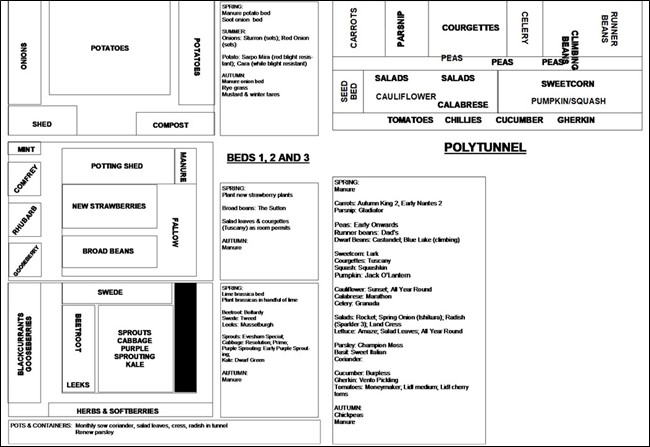
Try not to walk on the soil because we easily transfer disease on our boots from one bed to another. Always use a plank of wood to step on. (I learnt that from Monty Don!)
Here is a picture showing my garden plan for one year. You can see that I have recorded what seeds I have used, what was planted in each bed – even in the polytunnel - and which beds have been fertilised etc.
Seeds
Seeds come in many different shapes and sizes: seed packets offer what seem to be a complex range of varieties, some of which will grow well in your situation and others that will not. Experimentation or just talking to your neighbours to find out what works for them is the way forward.
Seeds come in many different shapes and sizes: seed packets offer what seem to be a complex range of varieties, some of which will grow well in your situation and others that will not.
Provided my potato crop was blight-free, I saved the very small egg-sized potatoes as seed for the next year’s crop. These were then ‘chitted’ in egg boxes until they had sprouted and were ready for planting sometime around Good Friday.
To grow onions from seed, sow them before Christmas. I always used onion sets (partly grown plants) which can commonly be found in any supermarket or garden centre from late winter. However, in the event of major problems, these may not be available. So, learning to keep and store seeds from one year to the next is an important part of the process.
For all other seeds – from beans to lettuce – always follow the guidelines in your food-growing ‘bible’ or on the side of the packet. Or simply allow at least one of your current year’s plants to go to seed, then dry the seed head. Store the dried seed in an envelope in a dry tin until sowing time.
In our community at the prayer house, we were able to do a bulk seed order and share packets of seeds which saved on costs. Packets generally have far more seeds than is practical for one household and they are often not suitable to save year-on-year. If you wish to save your seed, then avoid F1 hybrid varieties because these will be sterile.
Food preservation
We taught ourselves how to preserve the food we grew. This involved the construction of an insulated wooden chest for the root vegetables, jam-making, pickling and chutney-making; drying, dehydrating, freezing and learning the difference between bottling fruit using the water-bath method for short-term use or using a canning machine for longer-term preservation.
It is never too late to start!
Some useful tips: It is useful to keep a preserving diary to record the date of preserve and the quantity, as well as what worked well and what failed.
What you grow will largely depend on what you can also preserve well.
Join the journey
It is never too late to start! I have written about my ‘growing’ journey and shared some tried and trusted recipes from my storehouse, along with an easy guide to successful canning, in a recently published series of articles, which you can find in the Survive and Thrive page of the Issachar People website You need to subscribe as a member to view these articles and download the files.
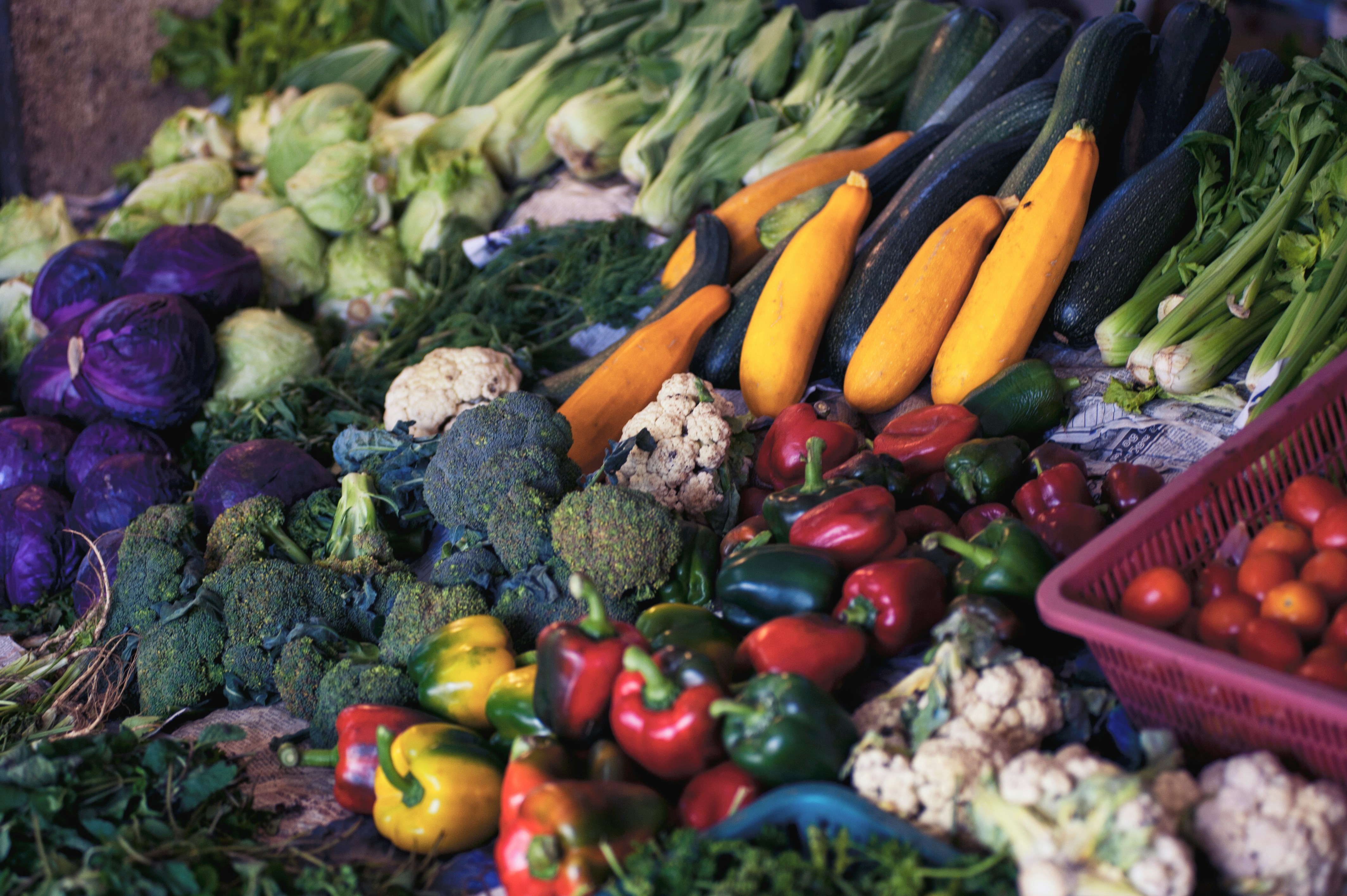
Image by Alexandr Podvalny on unsplash.com
Sarah Winbow, 12/02/2026