A Pattern for Renewal 4: God vs. Empire
A study of 2 Chronicles 32
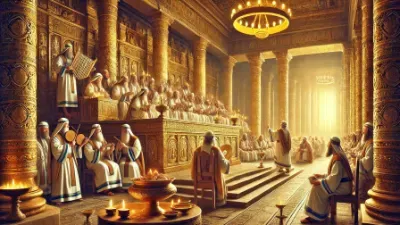 Nick Thompson has written a mini-series study on 2 Chronicles - A Pattern for Renewal - beginning with a consideration of chapter 29, Hezekiah’s restoration of Temple worship, following with chapter 30, Hezekiah's Passover, and chapter 31, Order in the House of God. This week, in the final part, he looks at the battle that followed the restoration of national worship, in chapter 32.
2 Chronicles 32 narrates one of the most dramatic confrontations in biblical history: the clash between the mighty Assyrian Empire and the small kingdom of Judah under King Hezekiah. While Assyria seemed unstoppable in its imperial campaign across the ancient Near East, Judah stood firm, not through military prowess, but through unwavering trust in YHWH. This followed the rededication of Judah to God, under the leadership of Hezekiah.
This chapter offers not just a historical account, but a deeply theological reflection on power, trust, and divine deliverance. Considering the effects of covenantal faith and obedience together with cosmic and spiritual impacts, this study examines Hezekiah’s faith under pressure, the role of Assyrian propaganda, and God’s miraculous intervention.
Contextual Note: The Assyrian Empire
Assyria was the superpower of the 8th and 7th centuries BC. Militarily advanced, administratively efficient, and ruthlessly brutal, it conquered most of the ancient Near East. Sennacherib (r. 705-681 BC) famously laid siege to Lachish and Jerusalem. Reliefs of his conquest of Lachish are displayed in the British Museum, depicting impalement, exile, and destruction.
But Assyria was not just a political entity. In the biblical worldview, it represented chaotic, idolatrous empire, a satanic archetype of rebellion (cf. Isaiah 10:5-19; Nahum 3). Assyria was an agent of divine discipline (Isaiah 10), yet ultimately subject to YHWH’s sovereign rule. Its defeat at Jerusalem is more than national survival; it is a cosmic vindication.
Assyrian Aggression and Judah’s Defence (2 Chronicles 32:1-5)
“After these things and these acts of faithfulness, Sennacherib king of Assyria came and invaded Judah...” (v. 1)
The opening verse juxtaposes faithfulness and invasion. Hezekiah’s reforms (chs. 29-31) do not exempt Judah from attack. In fact, covenant faith often invites confrontation. The lesson is that obedience does not mean exemption from trials; rather, it means we are equipped for them.
The lesson is that obedience does not mean exemption from trials; rather, it means we are equipped for them.
Assyria, under King Sennacherib, had already devastated the northern kingdom (Israel) and much of Judah. Jerusalem was now the primary target.
“He planned with his officers to stop the water of the springs...” (v. 3)
Hezekiah takes strategic steps, notably rerouting the Gihon Spring (cf. 2 Kings 20:20; Isaiah 22:9-11), creating the famous Siloam Tunnel. He also fortifies the walls and appoints military leaders (v. 5).
Life Application: Faith does not exclude prudence. Hezekiah’s trust in God includes proactive, intelligent preparation (Proverbs 21:31).
Faith in the Face of Fear (vv. 6-8)
“Be strong and courageous. Do not be afraid or dismayed... for there are more with us than with him.” (v. 7)
Hezekiah addresses the people with words reminiscent of Moses and Joshua (Deuteronomy 31:6; Joshua 1:9). The enemy’s army is vast, but Judah has something greater: the presence of YHWH.
The enemy’s army is vast, but Judah has something greater: the presence of YHWH.
“With him is an arm of flesh, but with us is YHWH our God, to help us and to fight our battles.” (v. 8)
Hezekiah’s actions are far more than political bravado; they are a cosmic assertion. In ancient worldview terms, YHWH is not just another god; He is supreme over all spiritual powers (Psalm 82; Isaiah 37:16).
Life Application: In crisis, faith proclaims divine reality over visible threat. Trust in God turns fear into courage (Romans 8:31).
Propaganda and Psychological Warfare (vv. 9-19)
“Thus says Sennacherib king of Assyria, ‘On what are you trusting...?’” (v. 10)
The Assyrians employ psychological warfare. Sennacherib’s officials question Judah’s confidence, mocking Hezekiah and YHWH:
“Has any of the gods of the nations delivered his land out of the hand of the king of Assyria?” (v. 13)
This blasphemous comparison equates YHWH with the powerless idols of other nations.
The Assyrian words are not simply political defiance; they are spiritual defiance. They constitute a direct challenge to God’s uniqueness and power.
“They spoke of the God of Jerusalem as they spoke of the gods of the peoples of the earth, which are the work of men’s hands.” (v. 19)
We note the cosmic battle motif here. The Assyrians, knowingly or not, are participants in a larger spiritual rebellion against the Most High God.
Life Application: The enemy will often attack your faith at its root. Don’t be surprised when the opposition mocks not just you but your trust in God. Stand firm (Ephesians 6:10-18).
Intercession and Divine Intervention (vv. 20-22)
“Then Hezekiah the king and Isaiah the prophet, the son of Amoz, prayed because of this and cried to heaven.” (v. 20)
Prayer becomes Judah’s greatest weapon. This united spiritual leadership, king and prophet, echoes the ideal biblical partnership. Isaiah, whose prophetic career spans Hezekiah’s reign, offers a theology of divine kingship and deliverance (cf. Isaiah 37).
“And YHWH sent an angel, who cut off all the mighty warriors...” (v. 21)
The Assyrian army is defeated without Judah lifting a sword. God intervenes supernaturally. 2 Kings 19:35 gives a parallel account: 185,000 soldiers die in one night.
This angelic deliverance is an action of God’s divine council: a heavenly emissary executing God’s will, reversing the threat of chaos.
“So YHWH saved Hezekiah and the inhabitants of Jerusalem...” (v. 22)
The word “saved” echoes the Exodus. This is a new deliverance, and Jerusalem becomes a new Zion, a defended sacred space.
Life Application: Prayer is not passive. It invites heaven to act. Spiritual battles require spiritual weapons (2 Corinthians 10:3-5).
Aftermath and Hezekiah’s Heart (vv. 23-31)
“Many brought gifts to YHWH to Jerusalem and precious things to Hezekiah... so that he was exalted in the sight of all nations.” (v. 23)
Judah’s vindication leads to international honour. Hezekiah becomes a type of messianic figure, a righteous king through whom God delivers His people.
“But Hezekiah did not make return according to the benefit done to him, for his heart was proud.” (v. 25)
A sobering warning. Prosperity exposes pride.
A sobering warning. Prosperity exposes pride. Though faithful in crisis, Hezekiah stumbles in peacetime.
“Hezekiah humbled himself for the pride of his heart... so that the wrath of YHWH did not come upon them in the days of Hezekiah.” (v. 26)
Yet humility returns. Hezekiah repents, and judgment is delayed. A vivid illustration of the necessity of ongoing humility for covenantal leadership.
“God left him to himself, in order to test him and to know all that was in his heart.” (v. 31)
There is a theological gem. Sometimes, God withdraws to reveal what truly governs our hearts. This mirrors themes in Deuteronomy 8:2.
God tests leaders not just in battle but in blessing.
Life Application: Great victories must be followed by great humility. God tests leaders not just in battle but in blessing.
Conclusion
2 Chronicles 32 is a testament to the power of trust in God amid overwhelming odds. Judah’s salvation is not earned through military might or political savvy but by steadfast faith and bold prayer. Hezekiah exemplifies godly leadership, though not without flaws.
Through our integrated lens, we see not only a historical account but a theological drama. The Assyrian menace, YHWH’s supremacy, and the sanctity of Jerusalem all converge to reveal a timeless truth: when God’s people trust in Him, no empire, however vast, can prevail.
Nick Thompson, 29/05/2026