Iranian Bombast
Western European Blindness: Naivety or Cynicism
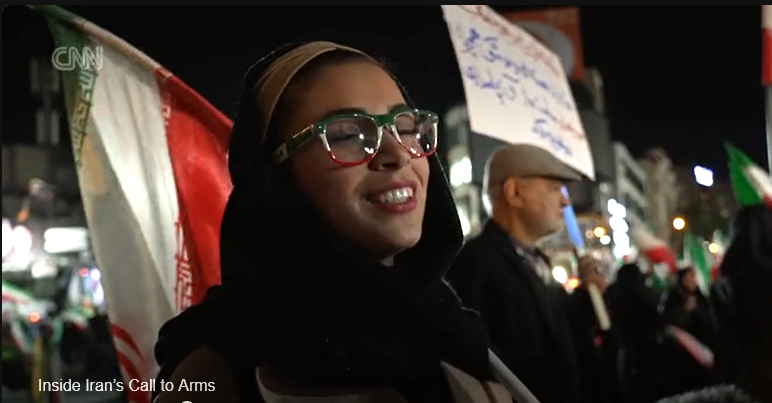 I watched a remarkable short film this week. It is called Inside Iran’s Call to Arms and was by CNN’s Matthew Chance, first broadcast on the 18th May, while the fragile ceasefire was still holding. The most revealing thing about this report from inside Iran was not what appeared on camera. It was the fact it existed at all.
Chance entered Iran under permission granted by the Islamic Republic itself. The network insists it retained full editorial control, and perhaps technically it did. But authoritarian governments do not grant foreign media access out of generosity, transparency, or commitment to truth. They grant access because they believe the resulting coverage will serve their interests. Every frame, every location, every interview opportunity exists because the regime calculated it would help shape an international narrative favourable to its survival.
That is the first reality Western audiences need to understand: this was not journalism conducted despite the Iranian regime. It was journalism conducted at the pleasure of it.
This was not journalism conducted despite the Iranian regime. It was journalism conducted at the pleasure of it.
Notwithstanding this Western media organisations remain astonishingly incapable of recognising when they are being used.
Understanding the Iranian Islamic Narrative
The segment opens with an Iranian woman declaring that she is prepared to die for her country. To Western ears, this sounds familiar, even admirable. We instinctively translate it into the language of patriotism, the kind of emotional resolve heard during wartime in Britain, America, or Israel. But that interpretation fundamentally misunderstands the ideological world the Islamic Republic inhabits.
The Iranian regime is not built primarily upon nationalism. It is built upon Twelver Shiite revolutionary theology, where martyrdom occupies a central and sanctified role. Death in service to the revolution is not framed as an unfortunate necessity. It is glorified as spiritual victory. The regime was forged in the blood-soaked mythology of Karbala, rooted in the death of Imam Husayn at the Battle of Karbala in 680AD, in which sacrificial suffering became central to political and religious identity.
That woman was not merely expressing willingness to endure war. She was articulating an aspiration shaped by decades of revolutionary indoctrination. Tehran wanted Western audiences to see that clip precisely because Western journalists often lack the theological and cultural literacy to interpret it properly. The regime understands that Western media tends to flatten all motivations into familiar secular categories, nationalism, grievance, resistance, pride, while missing the deeper ideological framework entirely.
Then comes the inevitable insistence that Iran needs nuclear weapons only for “peaceful” purposes.
The absurdity of this claim no longer even requires rebuttal. The Islamic Republic has spent decades funding proxy militias, destabilising neighbouring states, arming Hezbollah, enabling Hamas, orchestrating hostage-taking operations, and openly threatening the destruction of Israel. All while simultaneously demanding that the world believes its nuclear ambitions are purely civilian. Yet large sections of Western political and media culture continue treating Tehran’s declarations as though they emerge from the same conceptual universe as democratic diplomacy. They do not.
Then came the anchors with rifles.
It fears ordinary Iranians eventually turning against the regime itself.
One presenter awkwardly handled an AK-47 as though unfamiliar with even the basics of firearm use. Another fired a round dramatically into the studio ceiling. The scene was so performative, so transparently theatrical, that it bordered on parody. Yet beneath the absurdity lies a revealing truth about the regime itself.
Iran has a population of roughly 90 million people. Great Britain by comparison, has around 70 million. Yet Great Britain possesses vastly more privately owned firearms than the entirety of Iran. That disparity is not a cultural accident. It is deliberate state policy.
Authoritarian regimes disarm populations for one reason above all others: fear.
The Islamic Republic does not fear ordinary Iranians rising up against America or Israel. It fears ordinary Iranians eventually turning against the regime itself. The state monopolises violence because it understands the fragility hidden beneath its ideological spectacle.
Authoritarian regimes disarm populations for one reason above all others: fear.
Those rifles displayed on television were therefore not symbols of public confidence. They were symbols of elite insecurity. The regime wanted CNN to export images of unity, militancy, sacrifice, and revolutionary resolve. Instead, what emerged was something far more revealing: a government staging performative strength because genuine national confidence is evaporating underneath it.
This is where Western coverage becomes not merely shallow, but actively misleading.
Iranian Economics and the Importance of Oil
Because while cameras focused on choreographed patriotism, the actual story inside Iran is economic collapse. Iranian authorities have stopped publishing reliable GDP figures. The regime regularly manipulates or conceals economic data as a matter of institutional habit. Internet restrictions and information blackouts make independent verification difficult. Yet even the fragmentary evidence available paints a devastating picture.
Iranian conscript soldiers reportedly earn between approximately £50 and £120 per month depending on circumstance. Members of the IRGC, the regime’s ideological enforcement core, average around £240 monthly. That figure might sound manageable to Western readers unfamiliar with local conditions until one considers inflation levels inside the country.
Food inflation has reportedly exceeded 100 per cent year-on-year in key sectors. Basic living costs for a small family now exceed what many soldiers and workers earn. Meat has become an occasional luxury for large parts of the population. Savings evaporate almost immediately. Currency collapse has hollowed out entire sections of the middle class. Western audiences complain, often legitimately, about rising petrol prices and household pressure. However, Iran is operating on another level entirely. This is not economic discomfort. This is systemic degradation.
At the centre of it all lies oil.
At the centre of it all lies oil.
Iran’s economy survives through hydrocarbon exports, much of which historically moved through Kharg Island and the Strait of Hormuz. But sanctions, maritime pressure, and blockades have created mounting storage and export crises. Floating tankers now reportedly cluster offshore as temporary storage because export capacity cannot match production flows. Analysts warned months ago that storage saturation points were approaching rapidly. Production cuts followed soon after. This matters because the Islamic Revolutionary Guard Corps is not merely a military institution. It is an economic empire with guns attached to it.
The IRGC controls enormous sectors of Iranian infrastructure, telecommunications, logistics, construction, energy distribution, and sanctions networks. Its political loyalty depends not only upon ideology but upon patronage, financial privilege, and economic survival. Once revenue streams collapse, the regime faces a problem ideology alone cannot solve: payroll.
History repeatedly demonstrates that authoritarian systems often appear strongest immediately before fracture. The Shah’s Iran collapsed not solely because of abstract political theory but because economic pressure made ordinary life unbearable. The Arab Spring followed similar patterns. Long before revolutions become ideological, they become material. Populations tolerate oppression longer than they tolerate hopelessness. The Iranian regime understands this perfectly.
That is why it prefers foreign journalists filming women speaking about martyrdom instead of families discussing grocery prices. Because empty shelves destroy revolutionary mythology faster than foreign enemies do.
Yet Western governments and media organisations continue struggling to describe the Islamic Republic honestly.
Ideological Confusion
Part of this failure stems from ideological confusion. Western elites increasingly interpret all global conflicts through frameworks of grievance politics, anti-Western reflexes, or post-colonial guilt. As a result, regimes like Iran are often subconsciously treated less as imperial actors in their own right and more as reactive products of Western behaviour. But Iran is not merely reacting to the world. It is pursuing a coherent revolutionary vision.
But Iran is not merely reacting to the world. It is pursuing a coherent revolutionary vision.
Another part of the failure comes from fear, fear of escalation, fear of offending cultural sensitivities, fear of appearing simplistic or partisan. So, journalists retreat into euphemism. “Hardliners.” “Regional tensions.” “Complex dynamics.” Language becomes softer precisely where clarity is most needed.
Meanwhile ordinary Iranians continue paying the price.
This is the great moral contradiction hidden beneath much Western discourse on Iran: the people suffering most under confrontation with the regime are often the same people suffering most under the regime’s survival.
The Islamic Republic survives through perpetual crisis. It requires enemies externally because it fears collapse internally. Revolutionary systems depend upon permanent mobilisation. Without sanctions, conflict, martyrdom narratives, and ideological struggle, ordinary citizens might begin asking harder questions about corruption, repression, theft, and economic ruin. That is why the regime glorifies sacrifice.
Because sacrifice redirects anger outward.
The woman CNN filmed speaking about death for her country was not the true story of Iran. She was the story Tehran wanted exported. The real story is about a teacher who cannot afford food inflation. The young programmer watching his future disappear. The parent who is calculating whether meat is affordable this month. The citizen is disarmed by a state that fears him more than any foreign adversary.
Still much of the Western world refuses to see clearly.
Many Western governments prefer the illusion of stability to the uncertainty of genuine transformation.
There is another uncomfortable reality as well. Many Western governments prefer the illusion of stability to the uncertainty of genuine transformation. They fear regime collapse because collapse introduces unpredictability: refugee flows, regional instability, power vacuums, disrupted energy markets. So, the international system repeatedly settles into the familiar cycle of condemnation, negotiation, concession, and temporary containment. However, containment is not resolution, the status quo is not peace. It is managed deterioration.
How Long Can the Regime Survive?
The deeper question now is whether the regime can survive the accumulating pressure much longer. Economic exhaustion, growing public despair, collapsing legitimacy, regional setbacks, sanctions pressure, and internal distrust are converging simultaneously. That does not guarantee imminent collapse. Authoritarian governments can endure astonishing levels of dysfunction. But systems built on fear eventually begin fearing their own populations more than external enemies. That is why the guns stay in the hands of the regime.
That is why the spectacle on state television looked so strangely hollow.
Because propaganda works best when power feels secure. When governments begin staging revolutionary theatre with awkward presenters firing rifles into studio ceilings, it often signals not confidence, but anxiety. The performance Iran wanted the world to see lasted only minutes.
The reality unfolding beneath it may define the next decade of the Middle East.
Nick Thompson, 11/06/2026