When the Scarlet Wool Would Not Turn White (Part 1)
What the Days of Awe, Yom Kippur and Jerusalem’s destruction might teach the Church today
 There is something profoundly sobering about the approach of the Yamim Nora’im, the Days of Awe. They are traditionally understood as a period of self-examination, repentance and preparation leading from Rosh Hashanah towards Yom Kippur, the Day of Atonement. For Christians, these days are not a command to place ourselves under the Mosaic calendar. We do not need to become Jewish in order to learn from Israel's scriptures, festivals and patterns of worship. But perhaps we should be asking a different question.
What might the biblical and Jewish understanding of these days teach Christians about how to live before a holy God? There is one ancient tradition surrounding Yom Kippur that should make us stop and think. According to the Babylonian Talmud, something changed in the Temple approximately forty years before its destruction. The crimson wool wrapped around the horns of the goat held back in the Temple no longer turned white and the Jewish sages understood this as a sign. The question for us is not whether or not we should go looking for miraculous pieces of wool today. I would suggest that the deeper question is much more searching. Does God still warn His people when they are drifting from His purposes and if He does, would we recognise the warning?
Though your sins are like scarlet
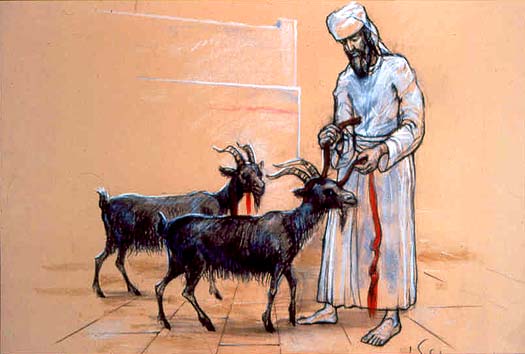
The starting point is Isaiah, where God speaks to Judah: “Though your sins are like scarlet, they shall be as white as snow; though they are red like crimson, they shall become like wool” (Isa 1:18). The imagery is unmistakable; scarlet represents sin, white represents cleansing and therefore the transformation of red into white becomes a picture of forgiveness. This imagery found a particularly powerful expression in the Temple rituals surrounding Yom Kippur. The Day of Atonement was the great annual day when Israel's sins were dealt with ceremonially through sacrifice, blood and the ministry of the High Priest. Leviticus 16 describes the ritual of the two goats. One was offered as a sacrifice, the other was associated with Azazel, whereby the sins of Israel were symbolically carried away into the wilderness. It was a remarkable picture.
The Day of Atonement was the great annual day when Israel's sins were dealt with ceremonially through sacrifice, blood and the ministry of the High Priest.
Sin was both covered and removed
The people could look at the ritual and understand something of the character of God. Sin matters; it separates us from God and must be dealt with. But God provides a way of atonement and that brings us directly to Jesus. John the Baptist sees Him and declares: “Behold, the Lamb of God, who takes away the sin of the world!” (John 1:29). What Yom Kippur rehearsed annually, Christians believe Jesus fulfilled decisively. The sacrifice was no longer merely anticipated. The Lamb had come.
The strange tradition of the crimson thread
The Mishnah and Talmud preserve traditions concerning a strip of crimson wool, lashon shel zehorit, associated with the Yom Kippur ritual. The Talmud records that during the forty years in which Shimon HaTzaddik served as High Priest, the crimson strip turned white. After that, it happened sometimes but not always. Then comes the extraordinary statement: during the forty years before the destruction of the Second Temple, the crimson strip did not turn white.
The same passage records two other ominous developments: the lot for YHWH no longer fell in the High Priests right hand, and the western lamp of the menorah ceased to burn continually. It then describes the Temple doors opening by themselves. I would suggest that we need to be careful here. These are rabbinic traditions recorded in the Talmud, not statements found in Leviticus or the New Testament. They should therefore not be treated as though Scripture itself explicitly predicts a miraculous crimson thread.
But that qualification does not make the tradition uninteresting; quite the opposite. If we approach it with the same attitude that Jesus and the disciples brought to 2nd Temple literature, then we can find it to be useful indeed. The rabbis themselves interpreted the phenomenon through Isaiah 1:18; the crimson becoming white represented atonement. The failure of the crimson to become white therefore represented the terrifying possibility that the expected sign of cleansing was no longer occurring - and the chronology is extraordinary:
The number (40) itself is not a mathematical formula for divine judgement, but the biblical pattern makes the rabbinic tradition all the more intriguing.
The tradition places the change approximately forty years before the destruction of the Temple. Jesus warned Jerusalem, then came the crucifixion, resurrection and ascension of Jesus, followed within weeks by the preaching of the apostles, which I believe took place in 30AD. Then came four decades of opportunity to repent and finally, in AD 70, Jerusalem and the Temple were destroyed.
Forty years of warning
Forty is one of those numbers in Scripture that repeatedly appears in contexts of testing, transition and preparation. Israel spent forty years in the wilderness; Moses spent forty days on Sinai; Elijah travelled forty days to Horeb; Jesus fasted forty days in the wilderness. The number itself is not a mathematical formula for divine judgement, but the biblical pattern makes the rabbinic tradition all the more intriguing.
If the Temple’s sacrificial system was beginning to show signs of failure approximately forty years before its destruction, then one could see the period between the ministry of Jesus and AD 70 as a final period of covenantal warning. Jesus’ words to Jerusalem become especially important: “O Jerusalem, Jerusalem, the city that kills the prophets and stones those who are sent to it!” (Matt 23:37), and then: “See, your house is left to you desolate” (Matt 23:38).
The words are devastating. Jesus does not merely predict a military catastrophe; He interprets what is coming in covenantal terms. The issue is not simply Rome; rather, Israel’s response to the One whom God has sent. Luke records Jesus weeping over Jerusalem: “Would that you, even you, had known on this day the things that make for peace!” (Luke 19:42).
Shortly afterwards, Jesus foretold the destruction of the city. The warning was not hidden; it was proclaimed. The signs, according to the rabbinic tradition, were not the beginning of the warning. They were perhaps the confirmation of a warning already being spoken through the prophets and ultimately through Messiah Himself. I suggest that the distinction matters enormously.
There is a danger. A danger that we become so fascinated by the sign that we miss the message.
The danger of reading signs backwards
There is a temptation, whenever we study prophetic signs, to become fascinated with chronology. We ask; what happened, when did it happen, what does it mean, what is the modern equivalent? They are legitimate questions, but there is a danger. A danger that we become so fascinated by the sign that we miss the message. The crimson wool was not the central issue; atonement was. The lamp was not the central issue; the presence of God was. The scapegoat’s lot was not the central issue; the people’s relationship with God was. The Temple doors opening was not merely supernatural theatre; it was a warning. I contend that the question, therefore, is not what miraculous sign should we look for, but are we listening to God before we require a miraculous sign? I think we find that approach much more uncomfortable.
Jesus’ generation had signs but ignored them
Jesus repeatedly warned that His generation was being confronted with something unprecedented. The Messiah was standing among them; the Kingdom was being proclaimed; the sick were healed, demons were expelled, the dead were raised; the Scriptures were being fulfilled. And yet many remained unwilling to repent.
Jesus said: “The men of Nineveh will rise up at the judgment with this generation and condemn it, for they repented at the preaching of Jonah, and behold, something greater than Jonah is here.” (Matt 12:41). The logic is straightforward: Nineveh had comparatively little revelation; Jesus’ generation had the Messiah Himself. The greater the revelation, the greater the responsibility. This is a principle that should make our contemporary Church tremble.
Could there be modern equivalents?
Once again, I suggest that we should tread carefully. I need to resist the temptation to announce any event as God’s modern crimson thread. I simply do not have the authority to say that. Equally, I should not attempt to identify every earthquake, political upheaval, economic crisis, eclipse, war or cultural transformation as a coded divine message. Jesus Himself warned against sensationalism. But that does not mean God is silent.
I should not attempt to identify every earthquake, political upheaval, economic crisis, eclipse, war or cultural transformation as a coded divine message.
Scripture repeatedly shows God warning His people, whether that be through prophets, circumstances, the consequences of sin, the removal of protection, the collapse of institutions, or even the quiet conviction of the Holy Spirit. Most significantly, sometimes through events that force a society to ask questions it had previously refused to ask. The New Testament gives us another important category: the Church itself can become a sign.
When the lampstand is moved
One of the most striking parallels comes from Revelation. Jesus speaks to the church at Ephesus: “Remember therefore from where you have fallen; repent, and do the works you did at first. If not, I will come to you and remove your lampstand from its place, unless you repent.” (Rev 2:5). That is pretty astonishing. The imagery of the menorah in the Temple is now applied to a church. The lamp represents witness and the Church is called to shine.
However, Jesus warns that a church can lose its place as a light. I see this as arguably one of the closest New Testament equivalents to the principle behind the crimson thread. It’s not a piece of wool, nor a mysterious astronomical event; and it’s certainly not a political prediction. A warning that the visible sign of God’s presence and purpose can be withdrawn is when His people refuse to repent and notice something else.
The church at Ephesus had not abandoned orthodoxy; it still had discernment, still had perseverance, and it had resisted false teachers. Yet Jesus could still say: “I have this against you, that you have abandoned the love you had at first.” The danger was not that they had stopped being religious; rather, that they had become religious without love. I suggest that little detail should frighten us more than almost any headline.
What might a modern crimson thread look like?
Perhaps it would not be supernatural at all; perhaps the signs God gives us are often painfully ordinary. A generation may become increasingly incapable of distinguishing truth from falsehood. A Church may become increasingly comfortable with sin. Christians may become increasingly hostile towards one another. Prayer may disappear, or scripture may be replaced by ideology. Repentance may be replaced by therapeutic self-affirmation, and holiness may be replaced by popularity. It might even be that mission may be replaced by institutional survival. Or even that the poor might become invisible, the stranger may become an inconvenience or sexual immorality may be celebrated. Financial greed could be interpreted as a blessing, or political allegiance may become more important than allegiance to Christ.
The tragedy is not simply that Israel lost a battle, but that Israel had become presumptuous about the presence of God.
The Church could still be singing and preaching, holding conferences and producing books. It could even still be filling buildings, and speaking Christian language. None of these things would answer the question as to whether or not the lamp is still burning.
The frightening possibility of Ichabod
There is an Old Testament word that I believe deserves renewed attention, Ichabod: the glory has departed. The context is the disastrous collapse of Eli’s priestly house and the capture of the Ark. The tragedy is not simply that Israel lost a battle, but that Israel had become presumptuous about the presence of God.
They carried the Ark into battle as though God’s presence could be manipulated. But God is not a talisman; the presence of God cannot be reduced to religious symbolism. The Church can make exactly the same mistake, we can possess the right Bible, the right doctrine, the right songs, conferences, the right terminology, even political opinions. Yet we can still drift from the living God. The question is never if we possess the symbols; but, rather, if we possess the substance?
We will carry this theme a bit further in a concluding article.
Nick Thompson
Image c/o https://www.biblejournalclasses.com
Nick Thompson, 14/09/2026